
A special education math curriculum is a customized approach to teaching math that supports students with disabilities. It focuses on clear, step-by-step instruction, hands-on learning, and skills needed for everyday life—like counting money, telling time, and measurement.
Why a Special Education Math Curriculum Matters?
A strong special education math curriculum gives students with disabilities the chance to learn math in ways that make sense to them. Many traditional math materials move too quickly or rely heavily on abstract concepts, which can leave students frustrated.
By adjusting pacing, breaking skills into smaller steps, and including hands-on learning, students can build confidence and independence. The goal is not just higher test scores—it’s helping students use math in everyday life.
Understanding the Learner Profile in Special Education Math
A successful special education math curriculum recognizes these needs and supports functional life skills like counting money, telling time, and measuring
Every student learns differently. Some struggle with memory, others benefit from visual models, and many need repeated practice to master skills.
Students with autism may learn best with routines and clear structure, while those with learning disabilities may need extra time and scaffolding. It should be flexible enough to meet academic and real-world goals.

Key Responsibilities of Special Education Teachers
Special education teachers play a crucial role in adapting instruction so students can thrive.
Develop Individual Education Plans (IEPs)
IEPs outline each student’s math goals and the supports needed to achieve them. Teachers assess current abilities, collaborate with families, and choose strategies that align with the math curriculum and build toward independence.
Classroom Management
A predictable and inclusive classroom helps students stay focused and feel safe. Positive behavior supports, visuals, and routines reduce anxiety and encourage participation during math lessons.
Instructional Strategies
Teachers personalize lessons through differentiated instruction, small-group teaching, and hands-on tools like manipulatives or virtual aids. Assistive technology—such as math apps or speech-to-text—can make learning more accessible.

Core Components of an Effective Special Education Math Curriculum
A high-quality curriculum includes:
- Explicit instruction with clear modeling and guided practice
- Step-by-step skill progressions to avoid gaps
- Visual supports that show how math works
- Math intervention activities for students who need more time
- Real-life application, such as using math while shopping
These pieces work together to help students understand not only what the answer is—but also how to get there.

Selecting or Designing a Math Curriculum for Special Education
| Criteria | What to Look For | Why It Matters |
|---|---|---|
| Alignment with IEP Goals | Lessons that connect directly to students’ goals | Ensures curriculum supports individual learning needs and growth |
| Flexibility & Adaptability | Adjustable pacing, differentiation options | Supports varied abilities and learning styles within one class |
| Repetition & Practice Opportunities | Frequent review cycles and built-in interventions | Reinforces learning and prevents skill regression |
| Progress Monitoring Tools | Data collection, visual tracking, checklists | Helps teachers adjust instruction and show progress |
| Visual & Hands-On Supports | Manipulatives, models, interactive tools | Makes abstract math concepts more concrete |
| Functional Life Skills Integration | Real-life math tasks embedded into lessons | Builds independence for daily living and future work |
| Accessibility & Assistive Technology | AT compatibility, large print, AAC supports | Ensures equitable access for all learners |
| Teacher Usability | Structured lessons with guidance and examples | Saves prep time and keeps instruction consistent |
Collaborating with Stakeholders
Working with Parents and Guardians
Families reinforce math skills at home. Simple routines—like reading recipes or counting items—build confidence. Regular communication keeps parents involved and helps students succeed.
Collaboration with Other Professionals
Speech therapists, psychologists, and occupational therapists provide insight into how students learn. Shared planning ensures consistent support across environments.
Implementation Strategies in the Classroom
Small-group instruction, concrete manipulatives, and visual schedules help students understand math concepts. Encouraging real-world practice makes learning meaningful and increases independence.
Continuous Professional Development
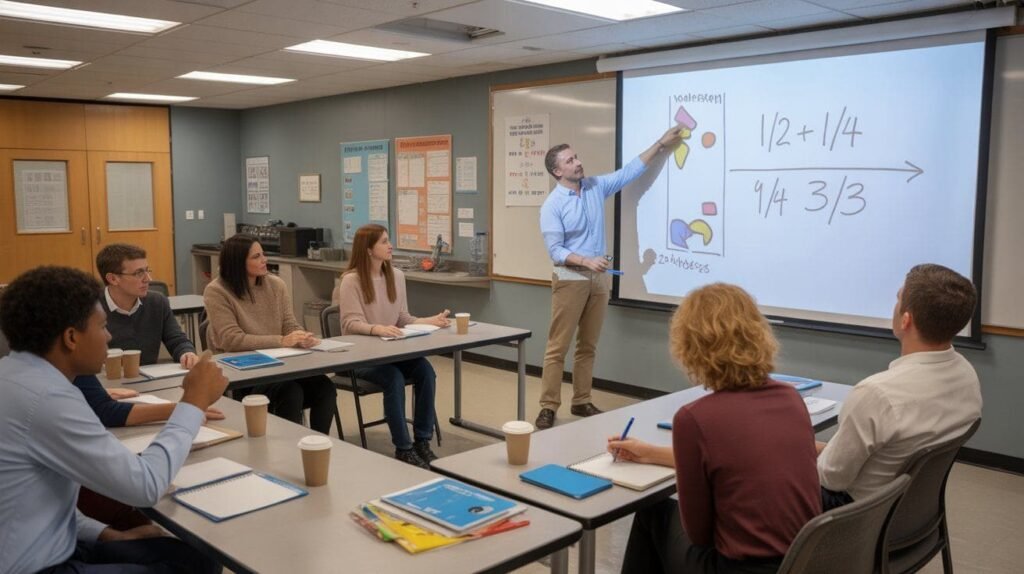
Special Education Teachers improve student outcomes by staying current with new instructional methods. Workshops, certifications, and peer collaboration strengthen math teaching skills and problem-solving approaches.
Challenges Faced by Special Education Teachers
Large caseloads, limited resources, and emotional fatigue are common challenges. Supportive teamwork, mentorship, and celebrating small victories help teachers stay motivated.
Measuring Success & Adjusting the Curriculum
Regular assessment shows whether students are making progress. When a strategy isn’t working, teachers adjust instruction to meet evolving needs. Flexibility keeps the special education math curriculum effective.
With the right math curriculum, students with disabilities can grow academically and gain crucial life skills. Teachers, families, and specialists working together make this success possible.
FAQ — Special Education Math Curriculum
Q1.What is a special education math curriculum?
It’s a flexible, supportive approach to math instruction designed for students with disabilities, focused on real-world skills and IEP goals.
Q2.How can parents help at home?
Integrate math into daily routines—shopping, cooking, time management, and games.
Q3.How do you adapt math instruction for special education?
Teachers use differentiated instruction, manipulatives, visual supports, assistive technology, and repeated practice to meet each learner’s math level and IEP goals.
References
National Council of Teachers of Mathematics. (n.d.). Teaching mathematics to students with disabilities [Position statement].https://www.nctm.org/Standards-and-Positions/Position-Statements/Teaching-Mathematics-to-Students-with-Disabilities/
Education Week. (2025, August 21). How should we teach math? General and special ed. researchers don’t agree. https://www.edweek.org/teaching-learning/how-should-we-teach-math-general-and-special-ed-researchers-dont-agree/2025/08