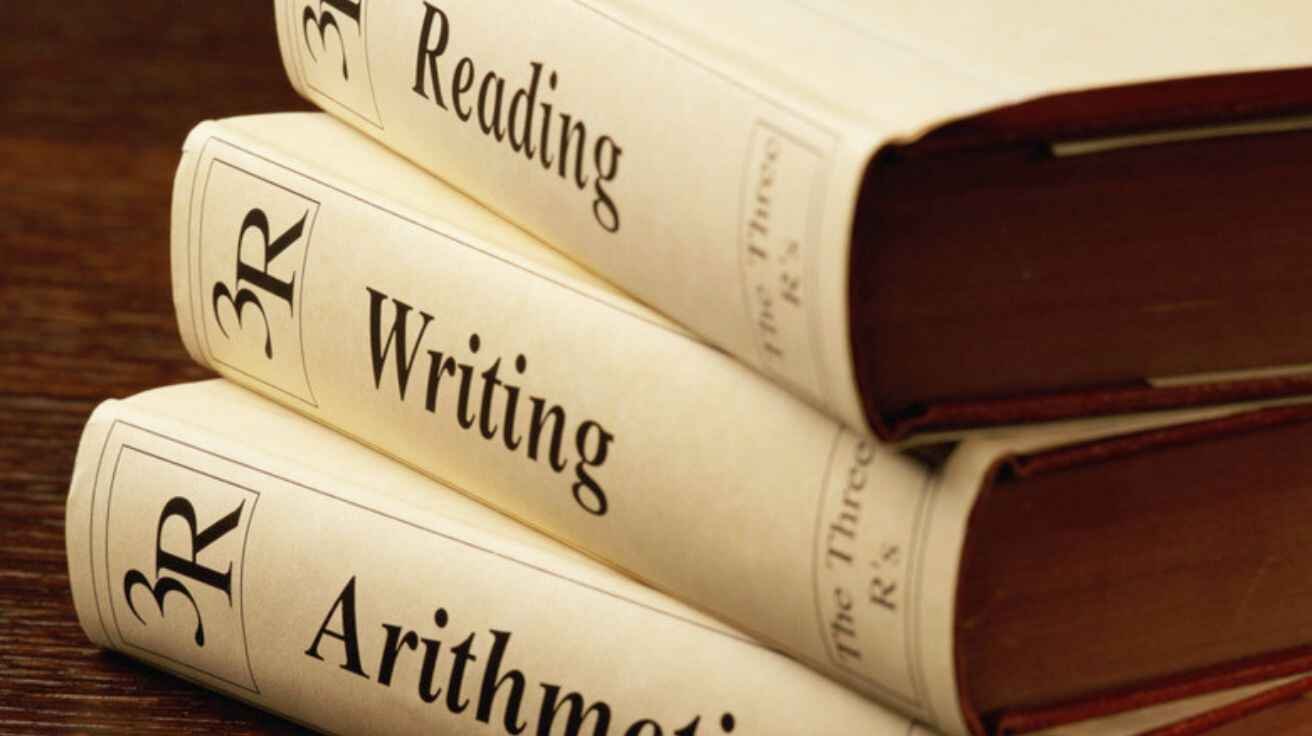
The 3 R’s of Education are Reading, Writing and Arithmetic — the essential skills that support all learning.
What Are the 3 R’s of Education?
The phrase 3 R’s of Education encompasses:
- Reading: the ability to decode text, comprehend meaning and engage with ideas.
- Writing: the ability to express thoughts, structure ideas and communicate effectively.
- Arithmetic: the ability to understand numbers, operations and problem-solve in everyday life.
A brief history and origin of the phrase “Three Rs”
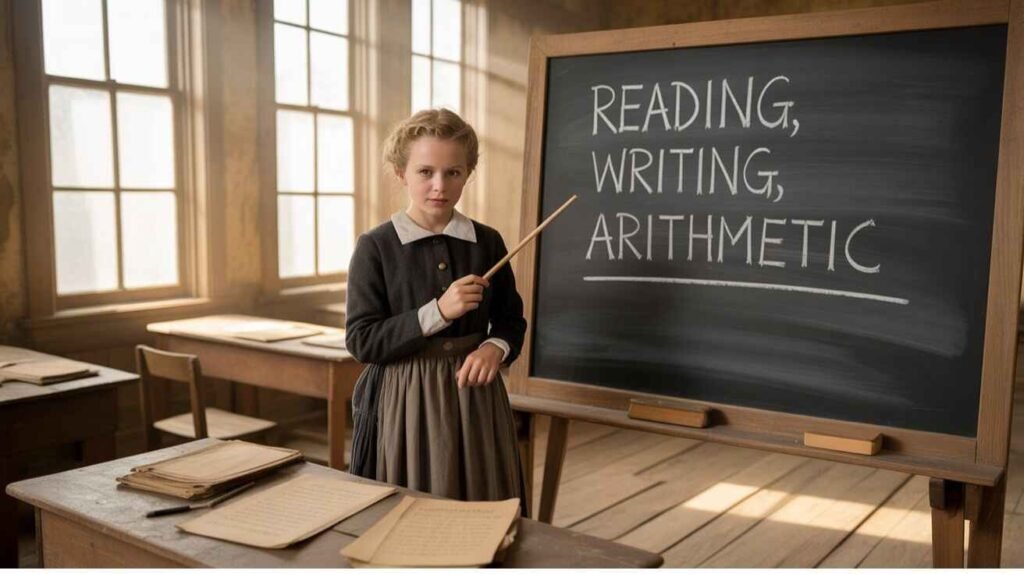
The “Three Rs”—reading, writing, and arithmetic.
The “Three Rs”—reading, writing, and arithmetic—first appeared in print in the early 19th century as shorthand for basic education. A story credits Sir William Curtis (c. 1807) with coining the joke “reading, writing, and arithmetic,” though historians see it as an urban legend.
Records from the 1820s–1830s show the phrase quickly spreading in schools and newspapers to describe essential learning. While the wording was new, the idea dates back to ancient scholars like St.
Augustine, proving these skills were long valued. By the 19th and 20th centuries, the “Three Rs” had become a universal symbol of elementary education.
Why the 3 R’s mattered historically
Reading, writing, and arithmetic were once the minimum skills needed for work, law, and civic life in industrial societies. As education spread, they became measures of literacy and social mobility, giving people access to jobs and learning.
Today, experts still see the 3 R’s as the base of all education, now expanded with digital and data literacy. In essence, they remain the foundation of informed citizenship and lifelong learning.
The Importance of Reading
Reading stands at the heart of the 3 R’s of Education.
Benefits of Reading
| Benefit of Reading | How It Supports Student Growth |
|---|---|
| Cognitive Development | Reading strengthens brain pathways that connect language and reasoning, improving memory, focus, and overall cognitive function. |
| Vocabulary & Comprehension | Exposure to new words and sentence structures helps students expand vocabulary and understand complex information more clearly. |
| Critical Thinking Skills | Active reading encourages students to analyze texts, make predictions, and draw conclusions — essential for academic and real-world decision-making. |
| Academic & Career Success | Strong reading abilities correlate with better school performance, improved workforce readiness, and lifelong learning habits. |
Strategies for Effective Reading
Implementing strong reading instruction reinforces the 3 R’s of Education.
Here are some effective practices:
- Daily reading habits: Set aside time each day for students to choose and engage with texts.
- Use a variety of reading materials: Fiction, nonfiction, and digital content support diverse literacy skills.
- Interactive approaches: Guided reading groups, book-club discussions, and shared reading help deepen comprehension.
- Phonics vs. Whole-Language: Explicit phonics instruction helps students decode words, while whole-language approaches emphasize meaning; combining both supports balanced literacy.
The reading component of the 3 R’s becomes more effective, helping students gain access to all other areas of learning.

The Role of Writing in Education
Writing is the second pillar of the 3 R’s of Education and goes beyond handwriting to include thought, revision, and communication.
Writing Techniques and Practices
| Writing Strategy | How It Supports Writing Development |
|---|---|
| Modeled Writing | Teachers demonstrate planning, structuring, and refining ideas by thinking aloud while writing. |
| Process Writing | Students draft, revise, and edit their work, learning that strong writing evolves through stages of improvement. |
| Feedback Loops & Peer Review | Constructive feedback highlights strengths and areas for growth, improving writing quality and confidence. |
| From Handwriting to Composition | Early transcription skills (handwriting/keyboarding) develop into composing, revising, and applying grammar correctly. |
Importance of Writing Skills
Writing enables clear communication in academic, personal, and professional life. It helps learners organize ideas, reflect on learning, and demonstrate knowledge.
Research shows that writing about what students read supports deeper thinking and comprehension.
Proficiency in writing is linked to academic success and critical engagement with content, making it a core component of the 3 R’s.

Arithmetic – The Foundations of Mathematics
Arithmetic, the third pillar of the 3 R’s of Education, underpins numeracy and logical thinking.
Why Arithmetic Matters
At its core, arithmetic includes number sense, operations (addition, subtraction, multiplication, division), mental math, and problem-solving.
These skills apply to daily life — budgeting, measuring, scheduling, and more. Research suggests that strong literacy skills support later success in mathematics, highlighting the interconnectedness of the 3 R’s.
Proficiency in arithmetic is also foundational for STEM readiness and modern quantitative reasoning.
Methods to Improve Arithmetic Skills
| Instructional Method | How It Builds Numeracy Skills |
|---|---|
| Practical Exercises & Games | Hands-on tools like manipulatives, number lines, and math challenges make arithmetic tangible and boost understanding. |
| Real-Life Applications | Using math in cooking, budgeting, or scoring sports helps students see the relevance of arithmetic in everyday life. |
| Mental Math & Computational Thinking | Encouraging mental calculations and pattern recognition helps students check accuracy and improve reasoning. |
| Data Literacy & Modern Numeracy | Students learn to interpret quantitative information, preparing them for STEM learning and informed decision-making. |

Integrating the 3 R’s of Education in Modern Curriculum
Modern teaching blends reading, writing, and math through real-world projects that connect subjects. For example, students may research, write, and budget for a single task—showing how the 3 R’s work together.
Technology strengthens this integration with adaptive learning, digital writing tools, and interactive math apps that build both literacy and numeracy.
This approach promotes critical thinking, collaboration, and digital readiness, keeping the 3 R’s relevant in a world focused on global skills and lifelong learning.
Integrating the “Three Rs” supports education reform and global competencies, ensuring that traditional foundations evolve with digital citizenship and lifelong learning at their core.
References
Noah Webster Educational Foundation. (2021, May 6). Why the “3 Rs” matter.
https://nwef.org/2021/05/06/why-the-3-rs-matter/
Wikipedia contributors. (2024). The three Rs. In Wikipedia, The Free Encyclopedia.
https://en.wikipedia.org/wiki/The_three_Rs